Saturday, August 21, 2010

How Small Are Yours ?

The Dwelle.ing prefab house (253 sq. feet/23.5 sq. m)


The interior of the Dwelle.ing house
Simple living, reduced economy access, and a desire to live an eco friendly lifestyle directs the house trend in these past few years towards small (even tiny) houses, with good design of course.

This article Dwelle’s Super Minimalist Prefabs Make Small Living Swell showcases a recent small house design made from a UK-based micro buildings designer.

These houses called Dwelle.ing are made from prefabricated (material manufactured in standard sections that can be easily shipped and assembled) and eco friendly material.

Yuka Yoneda wrote this article for inhabitat, a blog about sustainable design. Looking from the responses through social media (273 facebook likes and 57 retweet), this article generates quite a lot of attention among the blog readers.

Compare to the other article about the same subject (Dwelle.ing) in TinyHouseBlog, this article in inhabitat have more news hook and presented in the more succinct and appealing structure.

The Dwelle.ing article in inhabitat is more interesting because it is started with the most important fact: tiny footprint (the bigger one is only 253 sq. feet/23.5 sq. m). Then it continues with the next interesting fact: sustainable features such as insulation made from 100% recycled newspapers, double glazed windows and the ability to achieve zero-carbon status.

Not only the way it presented that makes it engages the readers, but also more than that is because the content of the article is thought provoking. Because it can develop a discussion among readers whether the space in this house in an appropriate living space for a person.

Image source(s): 
http://inhabitat.com/wp-content/blogs.dir/1/files/2010/08/dwelle-prefab-dwelleings-13.jpg
http://inhabitat.com/wp-content/blogs.dir/1/files/2010/08/dwelle-prefab-dwelleings-12.jpg

Tuesday, August 17, 2010

The Cell, Just A Bouncy Room? Or More?

How can a design connect with its appreciators?

Sydney Design 2010 try to answer this question through this year’s theme “tell us a story”.

Held in 31 July – 15 August, it’s a festival that incorporated more than 70 events in 25 venues. Some of the exhibitions have a fun yet thought-provoking feel, a good way to stimulate new ideas.

Through a series of vlog (video blog), creator of thedesignvlog.com Emma Elizabeth covers the excitement awaits in Sydney Design.

This vlog here is about one of the highlight in Sydney Design. In this vlog Emma Elizabeth interviews Brook Andrews about his installation shown in Sherman Contemporary Art Gallery that titled “The Cell”.

It’s a inflatable bouncy installation painted with traditional indigenous pattern. To experience the installation, the bouncers use a pattern jump suit provided, a crawl in a narrow tunnel and end up in a big bouncy room.

It supposed to be chill out room, a place that disconnect from the outside environment and think about complex issue such as intercultural, indigenous, asylum, or death.

The question is, will people who get inside and experience the installation caught up in the bouncing, relaxing, and laughing in the pattern custome? Or can they actually go beyond the fun part and fulfill the purpose of the installation to contemplate about those issues?

The use of video as a medium rather than writing in this case makes it easier for the audience to understand the shape, colour, and rooms in the installation, and how you can go inside it. It is simpler to describe a room through visual than verbal.


Image source: 
http://webservices.cofa.unsw.edu.au/system/landscape_images/96/resized/TheCell.jpg

Tuesday, August 3, 2010

Zaha Hadid's Curvaceous & Visionary ARTchitecture

Dubai Opera House, Dubai, United Arab Emirates
Guggenheim Hermitage Museum,Vilnius, Lithuania
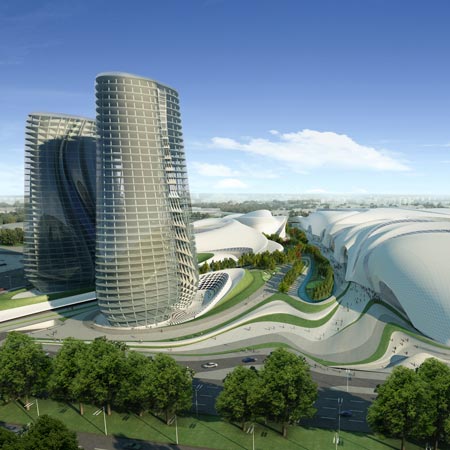
Cairo Expo City, Cairo, Egypt
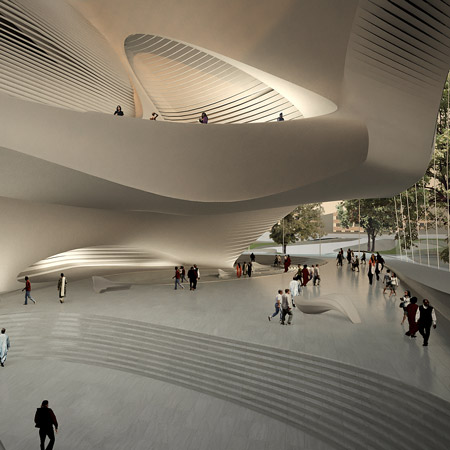
King Abdullah II House of Culture & Art, Amman, Jordan
What do you think when you first see these buildings?

For me it’s highly futuristic, fluid, organic, sculptural, and I can’t imagine the complex structure they use to build those. These are some of the architecture works of Zaha Hadid, one of the most prominent and visionary architects in our era.

Architect is a profession dominated by men. The I-wannabe-like-him list in architecture world is a long one. It’s filled by legends such as Frank Llyod Wright, Le Corbusier, Frank Gehry, Tadao Ando, Santiago Calatrava, and I can continue it for another hundred words. 

Before Zaha Hadid, I don’t think the I-wannabe-like-her list in architecture was even exist. She conveys womanliness in her design. When you see a building, you’ll know if it’s her work.

Some of her designs are too complicated to be built that they still sit in her office, waiting for the building technology to catch up to her.

Time magazine finally recognised her brilliance and included her in the list of 100 Most Influential People in The World.

To check out the article, click here.

Written by her fellow (fashion) designer Donna Karan, famous for the DKNY brand, this article briefly explains Karan’s personal experience with Hadid and also with Hadid’s design. It’s an interesting and in a way credible point of view, since Karan’s artistic sense as a designer is also undoubted. 

She captured Hadid in an engaging way through description such as “Her work is light and lyrical, like an Asian artisan's brushstroke captured forever in the environment”.

Different from most of the article about Hadid that usually start with list her awards and achievement, or mention the list of fashion label that have collaborated with her, this article offers something that not so may people have with Hadid: personal experience of having conversation and working together with her.

Written in a highly visual language, this article introduces Zaha Hadid to the readers from other field of knowledge, not only the design field.

Image sources:
Dubai Opera House, Dubai, United Arab Emirates: http://www.worldarab.net/sites/default/files/images/dubai-opera-house_sq_0.jpg
Guggenheim Hermitage Museum,Vilnius, Lithuania: http://www.tuvie.com/wp-content/uploads/guggenheim-hermitage-miseum-by-zaha-hadid3.jpg
Cairo Expo City, Cairo, Egypt: http://static.dezeen.com/uploads/2009/06/zha_cairo-expo-city_03_sq.jpg
King Abdullah II House of Culture & Art, Amman, Jordan: http://static.dezeen.com/uploads/2010/02/dzn_sq_King-Abdullah-II-House-of-Culture-Art_Lobby01.jpg